
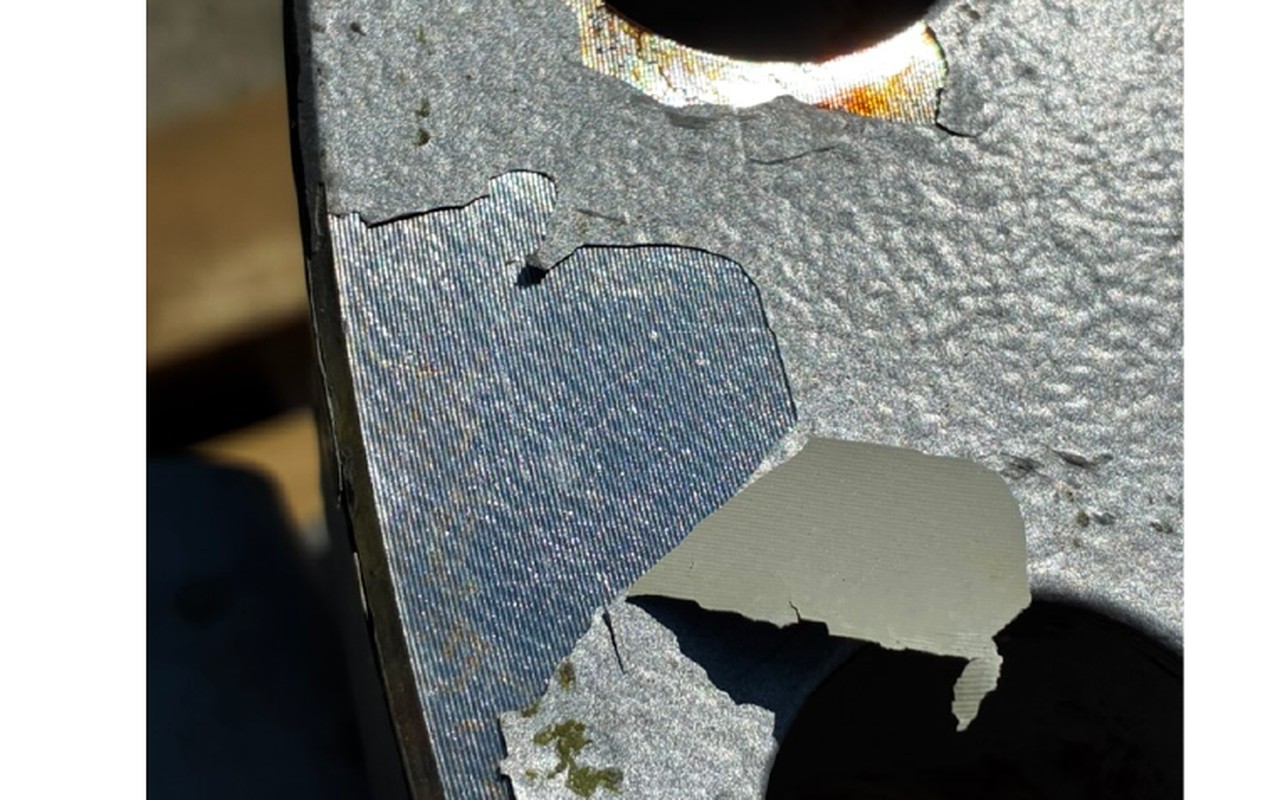
Key finding
The morphology is most consistent with adhesive failure at the metal-coating interface. The most likely combination is residual machining fluid contamination and insufficient controlled surface profile.
Why can a machined surface fail?
Visible machining grooves are not equivalent to an abrasive blast profile. They are directional and may provide limited three-dimensional anchoring. Cutting oil, coolant, emulsion or corrosion inhibitor may remain in the microgrooves, reduce surface energy and prevent full wetting by the primer.
Role of the water-break test
The test is most useful after degreasing and before abrasive preparation. A continuous water film indicates good wetting, while beading and dry islands suggest hydrophobic contamination. On a blast-cleaned profile it should be treated as a supplementary check because roughness complicates interpretation.
PDF study
Full analysis - 6 pages
The English edition includes annotated photographs, ranked causes, verification steps, repair guidance and relevant standards and literature.
References and sources
- ISO 4624 — Pull-off test for adhesion.
- ISO 8501-1 — Visual assessment of steel surface cleanliness.
- ISO 8503-1 — Surface roughness characteristics of blast-cleaned steel substrates.
- ASTM F22 — Hydrophobic surface films by the water-break test.
- AMPP Coating Inspector Program guidance on surface preparation and failure analysis.

Author
Branimir Krpez
Quality technician specialising in corrosion protection, protective coatings and quality control. On Zincor Systems, he publishes technical articles, analyses and case studies to share practical knowledge about corrosion and metal protection.
Send an email