
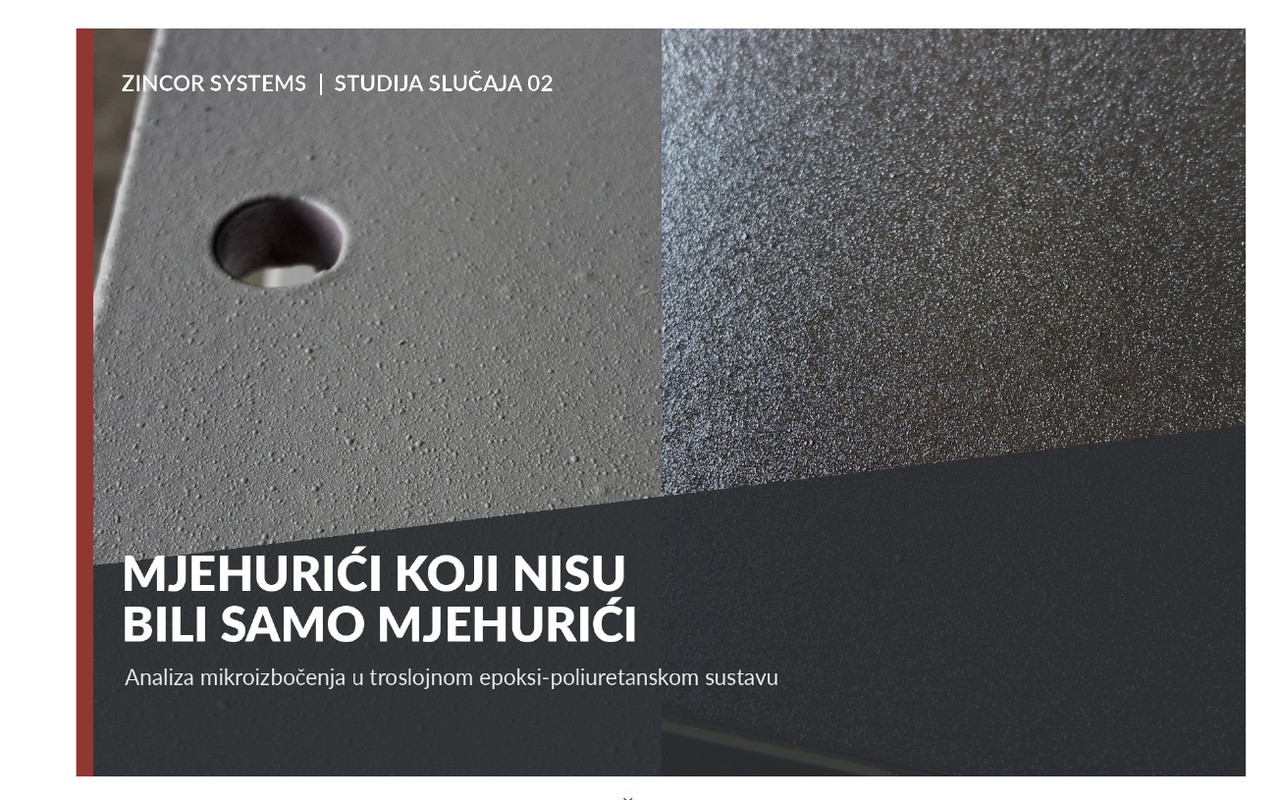
Key finding
The available evidence does not support an exceeded recoat interval or an isolated defect in one product as the primary cause. The strongest indication is wet-film contamination by airborne dust and fine residual abrasive particles, with heat, potentially high WFT and air movement increasing process sensitivity.
Working classification: a combination of nodular contamination, localized dry spray and possible solvent popping. The word “blisters” describes the appearance, but does not by itself prove a void or gas-filled core.
Dominant mechanism
Strong wind, abrasive and dust on the floor, together with active blasting, could have lifted particles and carried them into the enclosure. A particle that lands on fresh coating becomes a physical inclusion: the wet film partially wets and envelops it, leaving a hard nodular protrusion after curing. High temperature shortens the film's open time and can increase skinning, pinholing and popping, but does not by itself explain the observed spatial gradient.
Why is spatial distribution decisive?
The more exposed sides of the structure were affected more severely, while sheltered sides showed a substantially cleaner film. The same system, shift and geometry, but different exposure to contaminated airflow, provide stronger evidence of a local environmental cause than the appearance of a single protrusion. Recurrence with two different products further reduces the likelihood of an isolated manufacturing defect in one batch.
How could the cause be verified?
Photographs alone cannot reliably determine defect depth, the presence of a void or the layer in which the defect originated. The most valuable checks are opening representative protrusions, cross-sectioning and microscopy, a DFT map comparing affected and reference zones, and an ISO 8502-3 dust tape test before the next coating operation.
PDF study
Full analysis - 16 pages
The Croatian edition includes the chronology, climate readings, photographic analysis, differential diagnosis, mechanism comparison, verification plan, repair guidance, preventive controls and references.
On a mobile device, use the Download Croatian PDF button to open the document.
References and sources
- ISO 4628-2 — Assessment of degree of blistering.
- ISO 8502-3 — Assessment of dust on steel surfaces prepared for painting.
- ISO 2808 — Determination of film thickness.
- ISO 12944-7 — Execution and supervision of paint work.
- AMPP — technical guidance on coating defects and inspection.

Author
Branimir Krpez
Quality technician specialising in corrosion protection, protective coatings and quality control. On Zincor Systems, he publishes technical articles, analyses and case studies to share practical knowledge about corrosion and metal protection.
Send an email