
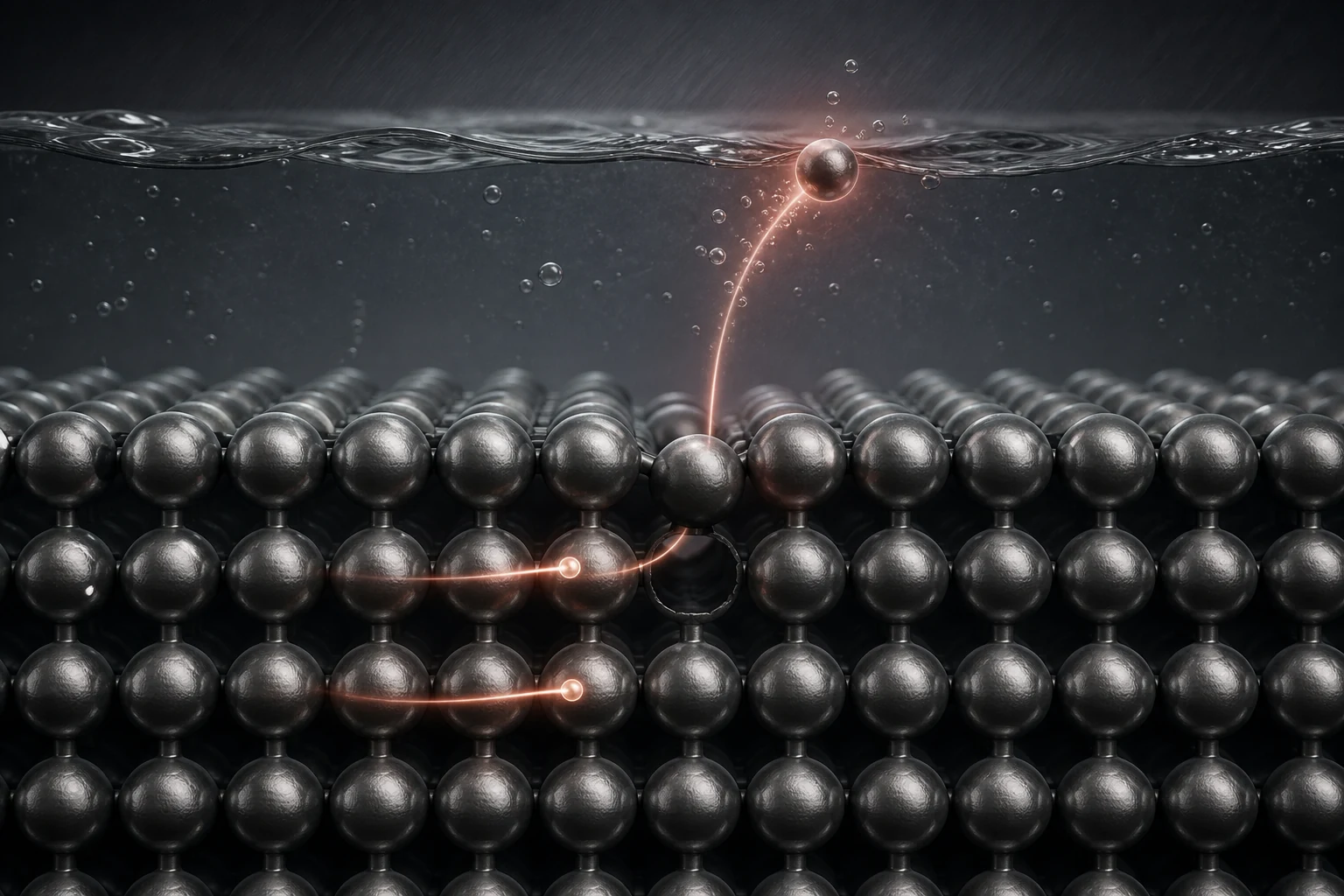
To understand why a metal corrodes, we must begin with a process that takes place at atomic scale. Whenever a steel structure rusts, zinc provides sacrificial protection to steel, or aluminium forms a protective oxide layer, metal atoms undergo oxidation at anodic areas.
In electrochemical corrosion, this process is often described as metal ionisation: a neutral atom loses one or more electrons and becomes a positively charged ion. This apparently simple reaction separates the path of the electrons from the path of the ions and allows the corrosion cell to continue operating.
What is a metal atom?
An atom consists of a positively charged nucleus, containing protons and neutrons, and negatively charged electrons. When the number of protons equals the number of electrons, the atom is electrically neutral.
A neutral iron atom has 26 protons and 26 electrons, so its overall electrical charge is zero. Metal atoms are joined in a crystal lattice, while their outer electrons can move through the metal and give it electrical conductivity.
What is an ion?
An ion is an atom or group of atoms with an overall electrical charge. When a metal atom loses electrons, the number of protons becomes greater than the number of electrons and a positively charged ion, or cation, is formed.
The symbol Fe²⁺ tells us that an iron atom has lost two electrons. It still has 26 protons, but it now has 24 electrons, giving it an overall charge of +2. In the same way, Zn²⁺ represents zinc that has lost two electrons, while Al³⁺ represents aluminium that has lost three.
Important: the number next to an ion symbol does not state how many electrons it contains. It states the ion’s overall electrical charge.
Ionisation and oxidation
Ionisation describes the formation of an ion, while oxidation describes the loss of electrons. In the context of anodic metal dissolution, the two terms describe the same event from different perspectives.
The letter M represents a metal and n is the number of electrons released. This is an anodic half-reaction. It cannot continue indefinitely on its own: the electrons must travel through the metal to a cathodic area, where they are consumed by a corresponding reduction reaction.
Why do metals lose electrons?
Atoms of different metals do not bind their outer electrons equally strongly. Their tendency to oxidise depends on their electronic structure, metal lattice energy, environment, pH, electrode potential and the stability of products that can form on the surface.
More reactive metals, such as magnesium and zinc, oxidise more readily in many aqueous environments than copper, silver or gold. Actual behaviour, however, is not determined by a metal’s position in the electrochemical series alone. Aluminium is highly reactive, yet in many conditions it is protected by a thin, compact passive oxide film.
Two paths after ionisation
When an iron atom becomes Fe²⁺, two separate paths are created:
- Electrons remain in the metallic phase and travel through the metal towards cathodic areas.
- Metal ions leave the crystal lattice and enter the electrolyte, where they can be hydrated, transported and involved in further reactions.
The electrons constitute electrical current within the metal, while charge is carried through the electrolyte by moving ions. A corrosion cell can continue operating only while both paths are available and a reaction at the cathode accepts the electrons.
From one atom to material loss
A piece of iron does not turn into rust all at once. Ionisation takes place atom by atom, mainly at microscopic anodic areas. Every atom that leaves the metal creates a vacancy in the crystal lattice.
The process can be compared with a wall built from millions of bricks. Removing a single brick is almost unnoticeable, but repeatedly removing many bricks from the same place eventually weakens the wall. In the same way, an enormous number of anodic reactions causes measurable mass loss, wall thinning, pitting or local damage.
The role of water and the electrolyte
In atmospheric electrochemical corrosion, water provides a medium in which ions can be stabilised and transported. A visible pool is not required: a thin film of condensation, dew, damp dust or water retained in a crevice can be sufficient.
Dissolved salts increase the conductivity of this film and make ionic charge transfer easier. This is why chlorides from marine atmospheres or road salt often accelerate corrosion strongly. Without an ionically conductive path, an electrochemical corrosion cell cannot be completed efficiently.
Why does zinc protect iron?
When zinc and steel form a galvanic couple, zinc oxidises more readily and acts as the anode:
The electrons released by zinc travel through the metal to the steel and support the cathodic reaction there. This suppresses the oxidation of iron. Zinc is therefore called a sacrificial metal: it is consumed in order to protect the steel, even where the zinc coating has suffered minor damage.
This is the basis of sacrificial-anode protection and an important part of the protective action of hot-dip galvanized and zinc-rich systems.
From iron ions to rust
Iron ionisation is not the final stage, but the beginning of a sequence of reactions. In neutral water, electrons are often consumed at cathodic areas by oxygen reduction, producing hydroxide ions:
Fe²⁺ ions then react with OH⁻ to form iron(II) hydroxide:
Further oxidation and reactions with water produce Fe(OH)₃, FeOOH, Fe₃O₄ and hydrated iron oxides. Rust is therefore not a single substance, but a variable mixture of corrosion products.
Common misconceptions
“Metal disappears because water simply dissolves it.”
In electrochemical corrosion, the metal atom is first oxidised and enters an ionic state. Only then is the ion stabilised and transported through the electrolyte.
“Electrons enter the water together with the metal ions.”
Electrons travel through the metal to cathodic areas. Charge is carried through the aqueous electrolyte by ions.
“Ionisation and the entire corrosion process are the same thing.”
Ionisation is the anodic half-reaction and the initial step in metal loss. Sustained electrochemical corrosion also requires a cathodic reaction, electronic and ionic paths, and suitable environmental conditions.
“A more reactive metal will always deteriorate rapidly.”
Corrosion rate also depends on passivation, the cathodic reaction, the electrolyte, temperature, geometry and the properties of surface films that form.
Conclusion
Metal ionisation is the initial and essential anodic step of electrochemical corrosion. A neutral atom loses electrons and becomes a positively charged ion. The electrons remain in the metal and travel towards cathodic areas, while metal ions enter the electrolyte and participate in further reactions.
Understanding this separation explains why metal is consumed at the anode, how rust forms, why zinc can protect steel sacrificially, and how coatings, passive films and cathodic protection interrupt or slow the corrosion process.
References and sources
- ISO 8044 — Corrosion of metals and alloys — Vocabulary.
- Mars G. Fontana, Corrosion Engineering, 3rd edition.
- Denny A. Jones, Principles and Prevention of Corrosion.
- R. Winston Revie (ed.), Uhlig’s Corrosion Handbook.
- Herbert H. Uhlig and R. Winston Revie, Corrosion and Corrosion Control.
- E. McCafferty, Introduction to Corrosion Science.

Author
Branimir Krpez
Quality technician specialising in corrosion protection, protective coatings and quality control. On Zincor Systems, he publishes technical articles, analyses and case studies to share practical knowledge about corrosion and metal protection.
zincorsystems@gmail.com